The main fear about AI is that 'neural networks will replace professions'. The reality from the latest WEF report turned out to be more cunning and unpleasant.
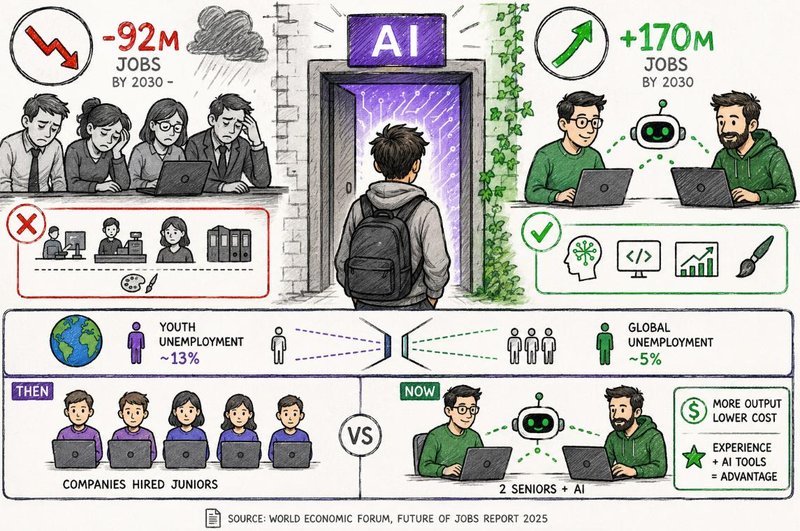
Yes, professions are shrinking: by 2030, ~92 million jobs will be displaced, but ~170 million will be created — a net gain of 78 million. On the chopping block are clerks, cashiers, secretaries, administrative staff. For the first time, graphic designers are on the list of dying professions, a direct consequence of generative AI.
But that's not what stings. What stings is who gets hit. AI doesn't so much replace as it transforms a profession into a 'senior + tool' combo. Companies find it more profitable to keep two experienced specialists with an AI subscription than a staff of beginners. And a junior's competitor for a position is not another junior, but the boss's neural network.
Hence the imbalance: global youth unemployment is ~13% while overall is ~5%. The door to the profession hasn't slammed shut, but the gap has narrowed.
I see this in myself. With Claude Code, one person handles a volume that would have required a team before. The winner is the one who already knows how — and who lets AI inside the work, rather than watching it from the outside. The most dangerous place right now is standing at the start of the path and waiting for things to 'sort themselves out'.
Source: World Economic Forum, Future of Jobs Report 2025