I once experimented with a poker bot: the engine calculated odds and equity, evaluated players by their stats and made decisions on its own. The project is on the shelf, but the hand history archive remains.
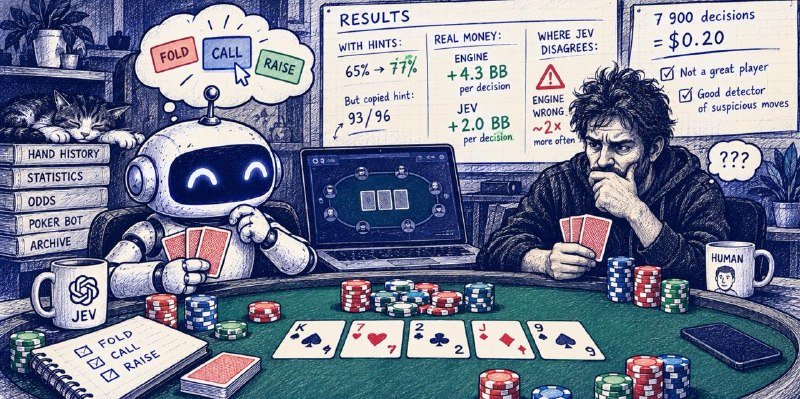
I tested Jev on it https://myitnotes.dev/en/post/instrument-421 — a fast neural network that doesn't reason, it just picks: fold, call or raise.
At first Jev played worse than the engine. I added hints — accuracy went up from 65 to 77%. I celebrated too early: the model was repeating the hint “the odds are good enough — call” in 93 cases out of 96.
I removed the hints and checked with money. The engine: +4.3 big blinds per decision,
Jev: +2.0. It guessed right more often, but folded the fattest pots.
On the other hand, it turned out to be good for a different role: where Jev disagrees with the engine, the engine is wrong almost twice as often as usual. Checking 7,900 decisions cost $0.20.
🃏Conclusion: Jev is a so-so player, but as a detector of suspicious moves it works.
ℹ️PS. About poker bots. A profitable bot does exist in the world, but only for heads-up games (one on one). For multi-player tables there's no profitable bot. (The exception is when several bots at a table collude against one live person - but that's pure fraud).